


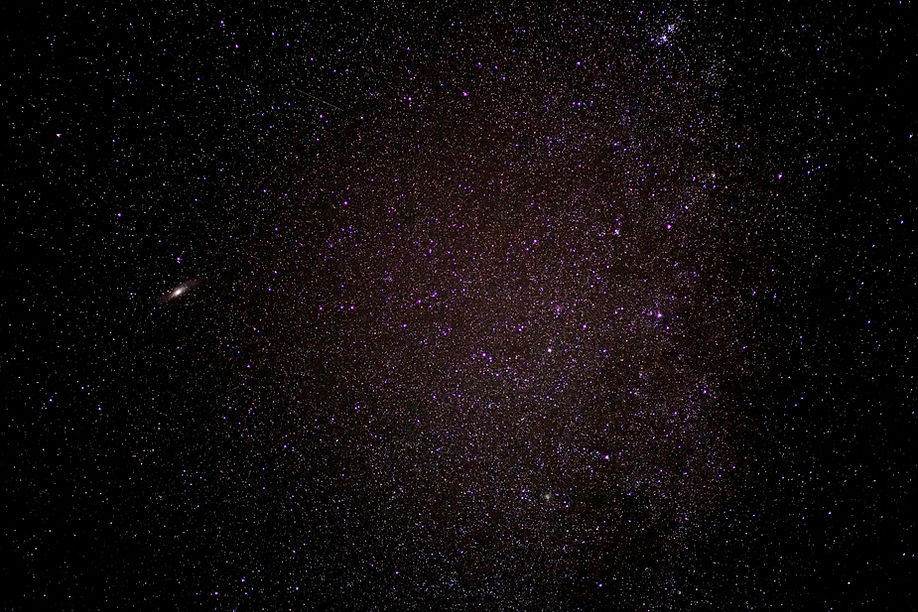
Beneath the unblinking gaze of Earth, the lunar south pole unfolds its austere majesty. Shackleton Crater looms, a jagged crown of stone where sunlight dances upon the rim, yet shadow reigns eternal in its depths, a cold so fierce it could splinter bone. Amid this unforgiving splendor rises Eos Base, its domes a testament to human daring. The silence here is a living thing, vast and heavy.
Commander John Anderson leads, a man of iron will forged in duty, his steady hands guiding a crew as diverse as the stars. Dr. Yuki Tanaka tends her greenhouse, coaxing life from sterile dust. Ahmed Hassan, master of machines, threads genius through circuits and steel, his laughter a rare spark in the gloom. Dr. Li Wei, lead scientist, burns with purpose, her eyes fixed on a dying world below, her every step a defiance of despair.
Their quest—helium-3, the Moon’s hidden treasure, lies locked within its ancient crust, a key to fusion’s boundless fire and Earth’s fragile hope. Eos Dawn of Fusion sings of resilience and the human soul’s unyielding reach, a tale etched in lunar stone where the future is forged one trembling step at a time.

Meet the Crew

Commander
John Anderson
Naval Academy graduate, twenty-eight years of service, the quiet steel that holds the crew together. John commanded undersea-rescue operations across the 2020s before being selected by Dr. Laura Simmons for the most ambitious off-world mission in human history. He carries the weight of every decision the way the Moon carries its craters — visibly, permanently, without complaint.
Behind the steady gray-eyed command presence is a man separated from his wife Emily and twelve-year-old son Jake back in Annapolis, a man who keeps Jake's pencil drawings of rockets folded in his uniform pocket through every shift. The crew sees the commander. Only John sees the father, the husband, the man trying to decide whether the mission is worth what it costs him at home.
"You don't lead from the front. You lead from wherever the next person needs you."

Psychologist
Sophie Dubois
The empathic anchor of Eos Base. A Lyon-trained clinical psychologist who spent the 2020s rebuilding crisis-response programs in post-disaster zones across Europe and North Africa, Sophie watches the crew the way a cartographer watches uncharted coastline — patient, attentive, missing nothing.
She carries a Saint Dymphna medal her late mentor gave her in 2017, the same year she lost her cousin Antoine and his daughter Élodie in the Quebec ice-storm cascade. The losses taught her that empathy is not soft — it is the hardest discipline there is. On Eos she catalogs every glance, every silence, every small unspoken thing the crew offers her. When something breaks, she will be the one already in the room, already listening, already painting open skies through the wall.
"I notice things. That's what they keep me for."

Engineer
Ahmed Hassan
The Cairo-trained nuclear engineer who keeps the reactor — and the entire base — running. Ahmed lost his wife Layla in the May 2025 October 6 Bridge collapse outside Cairo, and the depression that followed has been the quiet weight underneath every brilliant solution he has delivered since.
He carries an Iman Mersal poetry collection in his inner-left uniform pocket, the book Layla gave him on their last anniversary. His humor is dry as Saharan air; his competence is absolute; his exhaustion is invisible to almost everyone except the chief psychologist and the senior commander, who quietly accommodate it. On Eos he keeps the lights on, the air clean, the water cycling — the unglamorous infrastructure of staying alive on the Moon. The crew owes him their breath. He would rather they didn't notice.
"Mafīsh mushkila. No problem."
Geologist
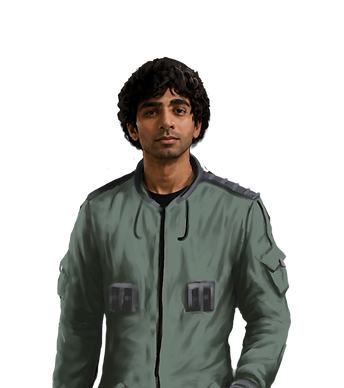
Raj Patel
The youngest crew member at twenty-one, the rookie whose cosmic-ray data work is operationally responsible for finding the helium-3 deposits that make ignition possible. Ahmedabad-born, IISc Bengaluru Ph.D. at nineteen, engaged to Bengaluru science journalist Anjali Sharma since 2031.
He carries a 25mm Celestron eyepiece his father Anil gave him on Diwali 2022 with the phrase that has shaped his life: "Beta, the sky is bigger than any room. Look up when you feel small." He carries it because of the elevator. April 2020, Ahmedabad blackout, nine-year-old Raj trapped for six hours, his mother Priya talking him down through the door with stories of ancient Indian astronomers. The Moon will test his claustrophobia, his belonging, his belief that data is more honest than people.
By Chapter 39 he knows the answer is both.
"Actually, the data says..."
Mining Engineer
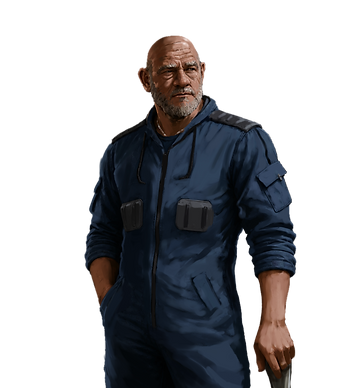
Ivan Petrov
Yakutsk-born Siberian mining engineer, the gruff Russian who carries an Aikhal kimberlite steel gear in his pocket — a piece he forged in his uncle Grigory's workshop at age twelve in December 1996. The gear has been on his body every working day for thirty-six years.
Divorced in 2025 after a long slow erosion he did not see coming until the Pavel-discovery in February 2024, Ivan is the working father of seventeen-year-old Anya, who lives with her mother in Novosibirsk and who is the reason he is on the Moon at all. He misreads the crew sometimes — particularly Zhang Wei — and the mission slowly teaches him to see them right.
By the end, Ivan has become the unexpected paternal presence half the crew didn't know they needed.
"Davay rabotat'. Let us work."

Geochemist
Dr. Li Wei
The brilliant abrasive intensity that pushes Eos Base toward the helium-3 deposits other crews would not dare to reach. Beijing-trained, never married by choice, Li Wei has dedicated her life to fusion energy with a fierce unparalleled single-mindedness.
Every kilogram of helium-3 she pulls from the lunar regolith is — in some honest accounting she rarely admits — for her brother Jun, for her sister-in-law Wang Liyuan, for the niece Mei-Ling she helped bring into the world through IVF in 2029. She carries a jade húlu pendant her grandmother gave her and recites the periodic table when stressed, a discipline she has practiced since October 2008.
"We do not have time for caution. The world is already running out."

Communications Officer
Sophia Rossi
The voice the crew hears most often from Earth and the voice the crew hears most often relaying Earth's news back — sometimes joyful, sometimes catastrophic. Naples-born, Bologna-trained, married sixteen years to investigative journalist Luca Rossi, Sophia is the cast's calmest professional in the most emotionally exposed seat at the base.
She wears a small silver pendant her grandfather Argentiere De Luca gave her at her First Communion in 1999 — etched with a Bay-of-Naples wave. She and Luca have no children after two miscarriages in 2020 and 2021 that they have stopped mentioning.
"Ci siamo. We are here."

Botanist
Dr. Yuki Tanaka
Tokyo-trained agricultural botanist whose tiny green world keeps a crew of twenty-six breathing, eating, and remembering Earth. Yuki tends the Eos Base greenhouse the way her late husband Hiroshi tended their Setagaya rooftop garden before his 2015 death — carefully, devotedly, talking quietly to the leaves.
She takes a fifteen-year-old kuromatsu bonsai her grandmother Hana gave her at age ten to Eos base and carries Hiroshi's small sketchbook in her inner-left uniform pocket. She has carried a private grief most of her colleagues do not know about — a 2014 miscarriage she has not spoken of in seventeen years. The greenhouse is where her grief becomes oxygen. When the crew is breaking, Yuki shows up with a fresh tomato, a sprig of basil, a small careful presence — and the room remembers it is still alive.
"Things grow. Even here. Especially here."

Robotics Engineer
Marcus Chen
Chinese-American robotics engineer with smudged glasses and grease-stained hands, Marcus is the quick-minded collaborative spark who keeps Eos Base's machines humming alongside Ahmed Hassan. Their synergy is one of the small operational pleasures of the mission — the dry-Egyptian-meets-quick-American working register that produces solutions the rest of the crew didn't know were possible.
Marcus' inheritance was not chosen; it was given. He carries it with the quiet engineer's discipline of someone who knows the mission depends on the next quick fix being ready before it's needed.
He doesn't say much. The work says it for him.
"On it."
Logistics and Safety
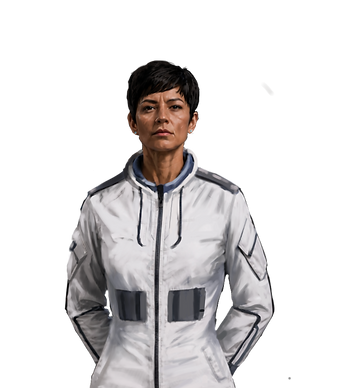
Lt. Colonel Maria Gonzalez
San Antonio-born Mexican-American USAF officer, twenty-seven years of service, the protocol-precision-and-quiet-care that organizes everything the crew does without anyone noticing. West Side daughter of bus driver Javier (Vietnam veteran) and seamstress Rosa, sister of Houston mechanic Miguel, aunt to eight-year-old Sofia.
Maria has been a widow for sixteen years. Her husband Luis — executive chef at Casa Esperanza — died in an April 2016 kitchen fire while evacuating four young employees through a back exit. The handwritten mole-recipe-card he wrote for her the day before lives in her uniform breast pocket. The Virgin of Guadalupe silver pendant from her mother sits on the silver chain under her uniform — three generations, 1937 to today.
She keeps the world steady. It is the work Luis told her she was made for.
"Vaya con Dios."

Robotics Specialist
Alejandro Martinez
The bright spark of Eos Base. Brownsville-born Mexican-American robotics engineer whose hand-carved bronze gear — made with his father Miguel on a Texas afternoon in February 2004 — rides in his pocket every day on the Moon.
Alejandro keeps the rovers running, the workshop humming, and the crew laughing through the worst of the lunar dust grind. His warmth is operational; his nephew Diego in Brownsville sends him robot drawings; his ex Carolina has remarried and Alejandro is genuinely happy for her. He is the kind of man you don't realize is essential until he is gone.
"No te preocupes. Don't worry. I've got it."

Geophysicist
Dr. Elena Morozova
The seismic precision counterweight that keeps the crew alive through every rock-related crisis. Novosibirsk-Akademgorodok academic Russian, daughter of geologist Viktor and librarian Irina, Elena has spent thirty years reading what the rock is about to say before it says it.
She carries a 470-million-year-old Asaphus trilobite fossil her father gave her at age eight, in a wooden box he made during the worst Akademgorodok salary-collapse year, inscribed "The rocks were here before us and will be after us." She never married. Her mentor Sergei Maximov died in the January 2024 Russian winter power-collapse when the hospital's ventilator support failed. The mission is, in some honest part of her interior, for him.
She is right when it matters. The crew comes to trust this slowly, quietly, completely.
"Posmotrim na dannye. Let us look at the data."

Geologist
Lena Müller
Lena is the steady, resilient German geologist whose practical Schwarzwald-trained sensibility translates the alien lunar surface into something the rest of us can understand. Husband Klaus, daughter Anna (12), son Lukas (9) are waiting in Freiburg with her parents Hans and Greta — the small ordinary family she chose this impossible mission to protect.
She carries a hexagonal Variscan quartz crystal her father gave her on the summit of the Belchen in 1996, and a folded A4 sheet labeled Unser Plan — Our Plan — listing every reason she had to come. Lena is the proof that resilience is not the absence of breaking — it is the discipline of standing back up afterwards.
"Wir schaffen das. We will manage it."

Materials Scientist
Dr. Nadia Kumar
Dr. Nadia Kumar makes materials do what materials should not. A materials scientist from Bengaluru, she is the last of the fourteen to arrive at Eos Base — carried up by a resupply Voidcraft two months into the mission.
She carries a small titanium shard from a Grade 5 alloy her father worked on at Bharat Electronics — pressed into her hand at twelve, with the principle she has spent thirty years refining: "The strongest material is not the hardest. It is the one that flexes without breaking and remembers its shape afterward."
Married to the poet Arjun, professionally famous, personally alone in ways she has learned not to name — Nadia arrives on the Moon believing what she has always believed.
"It will hold."

Structural Engineer
Fatima Al-Mansoori
Dr. Fatima Al-Mansoori builds the structures that hold. A structural engineer from Abu Dhabi's Al Bateen district, she carries a brass compass her father gave her at ten — with the words she has organized her life around: "The strongest structures are not the tallest. They are the ones that know their orientation to true north."
She learned that principle young. She built her career on it. She has needed it since 2018, when a construction-site failure left her husband Yusuf paralyzed from the chest down. Fourteen years of a marriage adjusted, held together by daily Al-Mutanabbi poetry and a love that did not go anywhere.
Now Fatima carries the compass to the Moon, where the composites she designs will decide whether the shelter holds when the sky comes down.
"The load is manageable. Insha'Allah."

Mission Architect, FusionTech Chief Scientist
Laura Simons
The Austin-based plasma physicist whose grief built Eos Base. Laura lost her husband Michael in a 2027 grid-failure cascade — one of the cascading energy-crisis deaths that pushed the world toward fusion as survival rather than ambition. She channeled that loss into FusionTech, into Helios-1, into the recruitment calls that brought every face on this crew to the Moon.
Trained as an analyst, made an outlier by grief, Laura is the institutional architect who fights Earth's battle while the crew fights the Moon's. Every name on the Eos roster — from Lt. Cmdr. Anderson down to twenty-one-year-old Raj Patel — came through her phone. She chose them carefully. She chose them with a calculation she has never named aloud.

Mission Control Liaison
Dr. Sarah Chen
The voice the Eos crew hears most often from Earth. Sarah is the vibrant Chinese-American astrophysicist who serves as the primary real-time communication bridge between Dr. Laura Simmons's team in Houston and the astronauts on the Moon — and later, the Ares Mars crew.
San Francisco-born, 44 years old at launch, she rose through the turbulent 2020s by coordinating international rescue missions during major solar storms and communication blackouts, earning a reputation for staying calm while delivering complex data with clarity and optimism. She translates astrophysics into human language, keeps morale high under the worst pressure mission control has ever faced, and lights up the screens with the kind of warmth that travels a quarter-million kilometers without losing power. Off-shift she does amateur astronomy from her rooftop telescope and cooks for friends.
"Houston copies. We're with you all the way."